The history of Korean popular music is divided into two periods: before and after the emergence of TV Chosun's "Miss Trot." The "Miss Trot" series, which debuted in 2019, elevated trot from a niche genre to the pinnacle of mainstream culture. Evolving with each season, it transcended mere audition competitions and became a massive industry.
Season 1: The 'Song Ga-in' Phenomenon, the Prelude to Trot's Resurgence

Season 1, which aired in 2019, directly challenged the stereotype that "trot is the exclusive domain of the elderly." Leading the charge was Song Ga-in, known for her overwhelming vocal prowess, followed by stars like Jeong Mi-ae and Hong Ja. It gave middle-aged and older generations a firepower rivaling idol fandoms, while also providing a refreshing new dimension to trot for younger generations. Notably, it fueled an unprecedented economic ripple effect, leading to a reversal in music charts and a revitalized performance industry, marking the beginning of the trot boom.
Season 2: The Birth of the 'Trot Idol' and the Enhancement of the System
Season 2, which premiered in 2020, significantly expanded the talent pool. Participants ranged from traditional Korean music majors to former idol trainees, broadening the scope of trot. Producing stars like Yang Ji-eun, Hong Ji-yoon, and Kim Da-hyun, this season perfected the "idolization of trot" through dazzling performances and elaborate stage production. The astonishing 30% viewership ratings proved "Miss Trot" had established itself as a national entertainment brand.
Season 3: The Completion of Generational Change... A New Era for 'MZ Trot'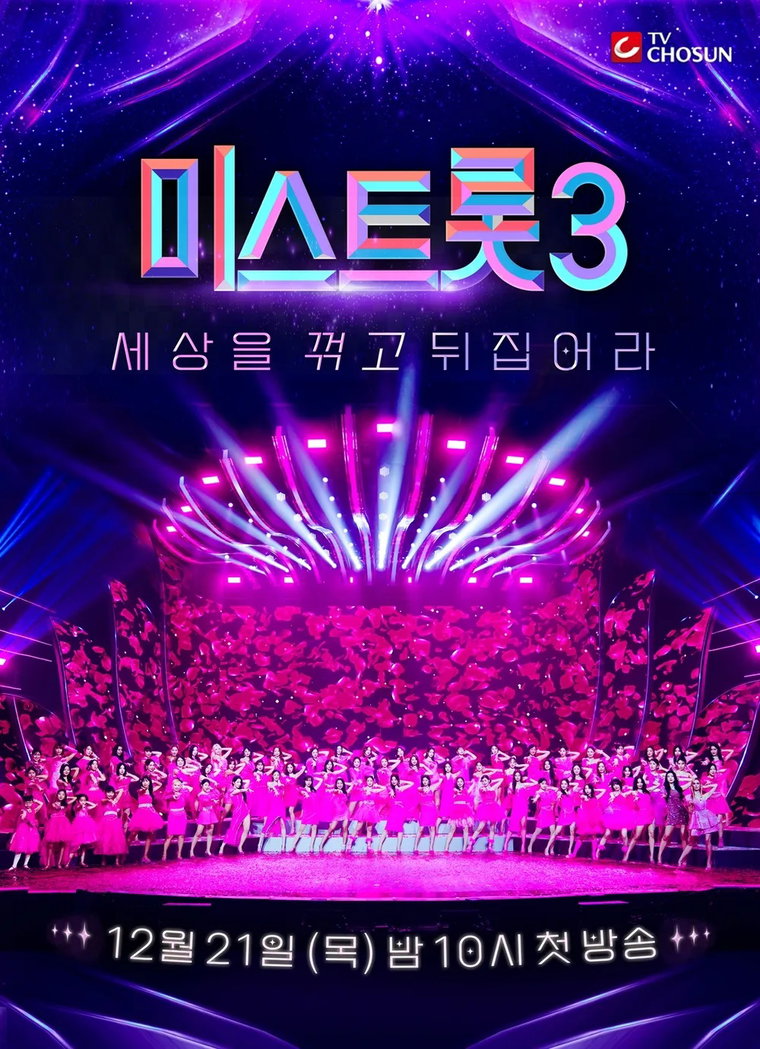
The recently concluded Season 3 highlighted a "generational shift." Young talent in their teens and early twenties, such as Jeong Seo-ju, Bae Ah-hyun, and Oh Yu-jin, stepped into the forefront, extending the vitality of trot. In particular, the show popularized "MZ Trot," which blends classic trot with pop and ballad sensibilities. Furthermore, the show's genre-specific round structure is praised for elevating musical perfection to the peak.
Season 4: Global Expansion and AI Judging, Tech-Powered Trot
The currently airing Season 4 has infused the essence of audition with cutting-edge technology and a global dimension. This season, the proportion of international contestants has noticeably increased, proving the potential for "K-Trot" to become a global phenomenon. Notably, efforts to strengthen fairness are evident, with a more sophisticated team of masters and a new judging system that enhances objectivity. The stage production also incorporates cutting-edge technologies like augmented reality (AR) to maximize visual enjoyment, demonstrating the epitome of an evolved audition.
The Secret to Unrivaled Status: Endless Spin-Offs and Incubation Strategies

The key to "Miss Trot" maintaining its unrivaled status among other audition shows lies in its robust post-production management. Beyond simply selecting a winner, the show consistently secures the contestants' star power through follow-up spin-off programs. "Miss Three", centered around the top seven from Season 3, has broadened its connection with the fandom and maintained its steady popularity. The currently airing Season 4 also maintains viewer engagement in real time through features like the "Miss Trot 4 Unreleased Special," which showcases charms not fully captured in the main broadcast.
This spin-off strategy creates a virtuous cycle in which the show is imprinted as the ‘most reliable debut route’ for participants and as a ‘trustworthy brand’ for viewers.
Here, the authority of the trot world's biggest masters, including Jang Yoon-jeong and Kim Yeon-ja, and the large-scale stage scale that overwhelms terrestrial broadcasting, have created an entry barrier that other similar programs cannot overcome. Attention is focused on what variations this brand, which has become the benchmark for auditions in Korea, will present in the future to shape the future of 'K-trot.'